
Common mistakes and the corresponding fines in the management of driver and vehicle documents in Dutch transport
Dutch transport companies often keep driver and vehicle documents in Google Drive. The common mistakes, and the ILT fines they lead to.

The transport business is difficult and resource-intensive, with a lot of moving parts, fluctuating fuel prices, many points of failure, and high responsibility.
On top of the core operations, transport companies are required to maintain a set of documents for each of their drivers and vehicles, a process that is mostly there to meet compliance needs and has nothing to do with the transport side of the business.
Naturally, the first approach of most transport companies is to solve this extra workload with the simplest setup that gets the job done, which is usually some version of the same thing: files on a shared Google Drive or OneDrive (or even simply on one of their computers), with a folder per driver, a folder per truck, a folder per trailer, and a spreadsheet somewhere that lists the files and their expiry dates.
It's an understandable setup. It costs nothing, everybody knows how to use it, and for a small fleet, it works. However, there are two issues with the classic setup:
- The spreadsheet gets exponentially more difficult to manage as the number of drivers and vehicles increases, with no clear view of the current status of the documents and upcoming expiries
- The folder has no idea what a file actually is and what it contains, which creates the risk of misplacing a document or mixing up two individuals with similar names, with no way to find the right file
Since the reliability of this simple system has no effect on the core operations, transport companies often find gaps in their documentation when it's too late and they are already being inspected by the ILT or the Nederlandse Arbeidsinspectie.
In this article, I'll go through the documents a Dutch transport company has to keep track of, the mistakes that keep showing up when they are managed manually, and what those mistakes cost in fines.
The documents a Dutch transport company has to keep track of
Before looking at the mistakes, it helps to see how much there actually is to manage. For every driver, a transport company typically needs:
- Driving licence for the right category (C or CE), usually valid for 5 years for professional drivers
- Code 95 (driver CPC), the proof of professional competence, renewed every 5 years after 35 hours of training. In the Netherlands, it is recorded on the driving licence itself, with its own expiry date. If the driver has obtained their Code 95 from another EU state, the Code 95 might be a separate document
- Tachograph driver card (bestuurderskaart), valid for 5 years
- A copy of the ID card or passport, front and back, which the employer has to keep in the payroll administration
- Employment contract
- Residence or work permit for drivers from outside the EU, and a driver attestation (bestuurdersattest) when they drive internationally for an EU carrier
- A1 certificate for drivers who work abroad
- ADR certificate for drivers who carry dangerous goods, valid for 5 years
- VCA certificate, the workplace safety diploma, for drivers entering high-risk industrial, construction, petrochemical, or heavy logistics sites
- TCVT certificate for drivers operating truck-mounted cranes
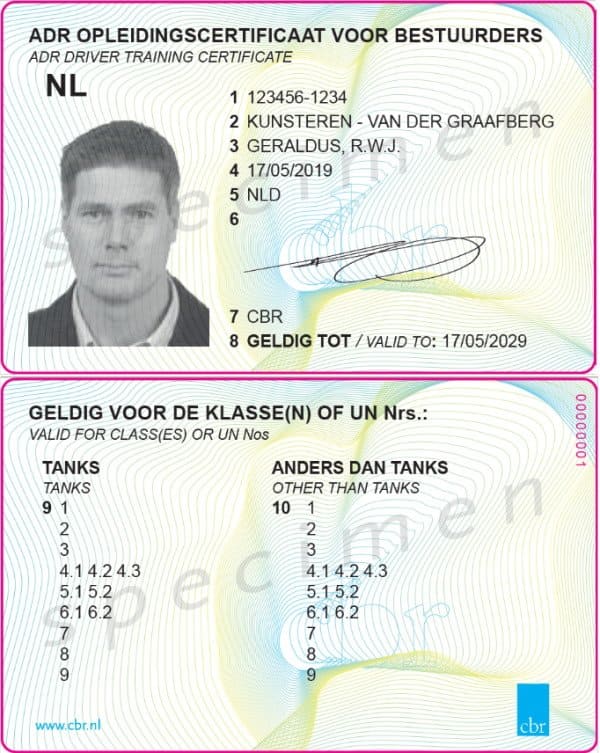
Sample of ADR certificate
And for every vehicle:
- Registration (kentekenbewijs)
- Insurance
- APK certificate, the report of the annual technical inspection, which is registered with the Dutch Vehicle Authority (RDW)
- Tachograph inspection, which has to be done at least once every 2 years
- Certified copy of the Eurovergunning (gewaarmerkt afschrift of the community licence), which has to be in the vehicle
- ADR certificate of approval for vehicles that carry dangerous goods
A company with 20 drivers and 20 trucks easily ends up with more than 200 documents they need to track and maintain, most of which expire at different times. The sheer number of documents, each with its own expiry date and processing time, is the core of the problems trucking companies face.
The common mistakes of managing documents manually
Just to be clear, none of the mistakes below are caused by careless people, and making one of them is not a reflection of your competence or professionalism. Rather, they are caused by a system that relies on busy people remembering things.
1. Expiry dates that nobody is reminded of
When the expiry date of a document lives in a filename or a spreadsheet column, it only helps if someone looks at it at the right time. Driving licences, driver cards, and Code 95 training all take weeks to renew, so noticing an expiry a few days in advance is often already too late. The driver either stops driving or drives without a valid document.
2. Tracking the licence but not the Code 95
This one is specific to the Netherlands (and other EU countries that enter the Code 95 expiry in the driving licence). Since the Code 95 is recorded on the driving licence, many companies only track one date per licence. But the licence categories and the Code 95 have their own expiry dates. A driver can have a valid licence and an expired Code 95 on the same card.
3. Scanning only the front
A lot of important information sits on the back of a card. The Code 95 we just talked about is a prime example. Having the front of the card and missing the back is one of the most common shortcomings of a document profile.
4. No checklist per driver
A folder shows what is there, not what is missing, as the folder has no sense of what is required. There are many different scenarios where the company starts with an incomplete set of documents and waits for the other documents to become available. Unless someone remembers to follow up and add them, or keeps a separate note or spreadsheet, nothing in a folder structure points to the gap.
5. Not knowing which version is current
At the beginning, the folder of a driver or vehicle is clean, and there's only one copy of each document. As time goes by, every document gets multiple copies, each with a slightly different name. Sometimes, the renewed file replaces the old one, wiping the history. That can be a problem, because during an inspection, having the current version is not enough, and you might be asked to show the document that was valid on a specific date.
6. Deleting too early, or keeping forever
The employer has to keep the copy of an employee's ID for five years after the year the employment ends. Delete a former driver's folder to tidy up, and that copy is gone. Keep every folder forever, and you hold personal data longer than the GDPR (AVG) allows.
7. Sharing more than you should
Driver folders contain ID copies, BSNs, and sometimes medical information. A shared Google Drive link that is set to "anyone with the link", or a former planner who still has access, is a data breach waiting to happen. Under the GDPR, a breach with a risk to the people involved has to be reported to the Autoriteit Persoonsgegevens within 72 hours.
8. Vehicle documents are sometimes nobody's job
Driver documents belong to a person. The roles of HR and the planner are also well defined. So, usually, one or two people are in charge of handling drivers' documents. However, when it comes to vehicles, the role is often not very well defined, and the task is spread between the directors, the fleet manager, and the workshop, which can lead to organizational confusion where one person assumes the other will take care of it.
9. The process is time-consuming, so it's constantly postponed until it's too late
Keeping up with compliance and having an organized set of documents does not bring any revenue to a transport company. It's purely administrative work that understandably feels like extra work with a low priority. When the process and tools involved in managing these documents take a considerable amount of time, companies often postpone sorting the documents until they need a document or the backlog of pending documents becomes unmanageable.
What it costs in an inspection
The ILT can inspect at the roadside (transport inspection) or at your company (company inspection), where it goes through your records. The fines are set in a public fine catalogue. Here are some of the standard amounts that relate to records and documents:
- Driver card data not downloaded at least every 28 days: €1,300 for the employer
- Vehicle unit (tachograph) data not downloaded at least every 90 days: €1,300 for the employer
- Downloaded tachograph data not kept for 12 months: €1,300 for the employer
- Tachograph not inspected within 2 years: €450 for the employer
- Driving without using a driver card: €1,500 for the driver
- Driving with someone else's driver card: €4,400 for the employer and €1,500 for the driver
Employing a driver from outside the EU without a valid work permit falls under the Wet arbeid vreemdelingen and is enforced by the Nederlandse Arbeidsinspectie. The standard fine for a company is €6,000 per worker, and it can go up to €11,250.
And if the ID copy of an employee is missing from the payroll administration, the Belastingdienst can apply the anonymous rate (anoniementarief): the highest wage tax rate, without any tax credits, instead of the normal one.
Why the amounts add up quickly
The amounts above are the starting point, not the end result:
- Every offence is fined separately, and the amounts are added up
- The amount depends on culpability (how responsible you are). It can be halved for reduced culpability, or multiplied by 1.5 for gross negligence and by 2 for intent
- Repeat offences cost more. If the company is fined again within five years, the fines are increased, and the maximum the ILT can impose in a single inspection doubles. For work permits, repeat offences within five years increase the fine by 50%, 100%, or 200%
A single company inspection that finds late downloads, a tachograph that is overdue for inspection, and a driver with an expired card can easily cost several thousand euros. Finding the same problems again within five years costs even more.
From folders to a system that knows what's missing
The fix for all of the mistakes above is the same: instead of a place where files are arbitrarily stored, you need a system that knows which documents each driver and each vehicle should have, and that tells you, ahead of time, what is missing or about to expire. That's why we built RePloyee.
Ready-made profiles for Dutch truck drivers
RePloyee comes with presets for truck drivers in the Netherlands. The "Truck Driver (Netherlands)" role already requires the driving licence, Code 95, tachograph driver card, ID card or passport, and employment contract. For drivers who work abroad, you add the cross-border role, which requires the A1 certificate and offers the driver attestation and residence or work permit. For dangerous goods, you add the role that requires the ADR certificate. You can add and remove the roles as needed.
Because the driving licence and the Code 95 are separate requirements, each one gets its own expiry date, so an expired Code 95 doesn't hide behind a valid licence.
Front and back, together
Preset requirements know whether a document has a front and a back. For an ID card, driving licence, or driver card, RePloyee asks for both sides and keeps them under the same document, so the back is never forgotten.
Warnings before it's too late
Each requirement has its own notice days. For a driving licence, for example, you're warned 90, 30, and 7 days before it expires, which leaves enough time to book the renewal. The overview shows what expires in the next 30 days and lists every driver who is missing a required document or holds an expired one. You don't have to check it every day: RePloyee checks every night and sends the alerts in a daily email.
Vehicle documents, managed the same way
RePloyee manages vehicle documents in the same way as driver documents. Each truck or trailer gets its own profile with the documents it needs, such as the tachograph inspection, the APK, and the certified copy of the Eurovergunning. Expiring and missing vehicle documents show up alongside those of your drivers, so the tachograph inspection that is due every two years is no longer somebody's memory.
Kept for as long as required, and only seen by the right people
RePloyee lives in a Vieolo business workspace, where you decide who can see what. Give an employee a higher sensitivity level, and only members with a matching access level can see them and their documents. When a driver leaves, you deactivate them instead of deleting their documents, so their records are still there when you need them, without cluttering your overview.
Frequently asked questions
How often must a Dutch transport company download tachograph data?
According to the ILT, the data on the driver card has to be downloaded at least every 28 days, and the data in the tachograph itself at least every 90 days. The downloaded data has to be kept for at least one year.
How long must an employer keep a copy of an employee's ID?
The copy has to be kept in the payroll administration for five years after the end of the year in which the employment ended.
Is the Code 95 separate from the driving licence in the Netherlands?
The Code 95 is recorded on the Dutch driving licence, but it has its own expiry date. It has to be renewed every five years after completing 35 hours of training, independently of the licence categories.
How often must a tachograph be inspected?
A tachograph has to be inspected by an approved workshop at least once every two years. Missing the inspection is a €450 fine for the employer.
Who gets fined, the driver or the company?
Both, depending on the offence. The driver is fined for things that happen at the wheel, such as not using a driver card. The company is fined for its records and its vehicles, such as late downloads or an overdue tachograph inspection. For some offences, such as using someone else's driver card, both are fined.
Try it with your own drivers and trucks
If your driver and vehicle documents live in folders today, the quickest way to find out what's missing is to put them in a system that tells you. Create a Vieolo account, add the "Truck Driver (Netherlands)" preset, and add your first drivers and trucks. The overview will show you what's missing within minutes, rather than during an inspection.